
Lesson 5
Manage the position without changing the story
Understand partial exits, remaining risk and why “break-even” is not cost-free.
Study time: about 10m
Lesson
Decide management rules while you are flat. Your plan might use a fixed exit, a partial exit plus a remaining target, or a predefined structure-based trailing rule. Each produces different outcomes. Combining whichever rule looks best after the move makes the record impossible to evaluate.
A partial close realizes profit or loss on only the quantity filled. Confirm the remaining position and amend linked protective orders appropriately; platform behaviour varies. Do not assume an old stop quantity automatically matches a smaller position.
Moving a stop to the entry price is often called break-even, but fees, spread and slippage can still produce a loss. Tightening an exit also changes the chance of being stopped by ordinary price movement. Record the management rule and actual fills rather than describing a trade as “risk-free.”
Worked example
You buy four hypothetical units at 100, with an initial stop at 98. Each unit is worth $1 per point, so gross initial risk is $8. Two units exit at 102 for $4 profit; the other two exit at 98 for $4 loss. Gross result is zero, before costs. Reaching the first target did not make the whole trade a winner.
Try it in replay
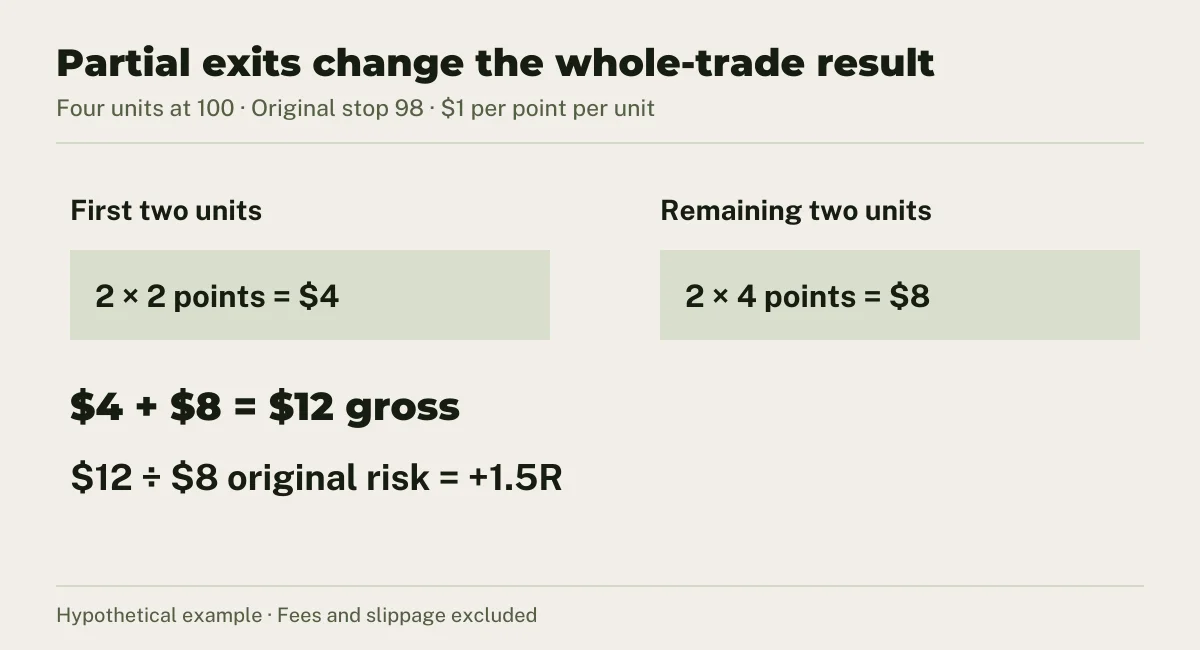
Recalculate the example if the remaining two units exit at 104. Express the gross total as a multiple of the original $8 risk.
Check your reasoning
The first portion earns $4 and the remainder earns $8: $12 total, or +1.5R before costs. Keep the original risk denominator so partial exits remain comparable.