
Lesson 2
Size the trade from the loss budget
Calculate a permitted size using stop distance, point value and estimated costs.
Study time: about 10m
Lesson
Begin with a loss budget you chose before seeing the setup. An educational example cannot choose the right budget for your finances. Convert the entry-to-stop distance into money per unit using the actual contract specifications, then include an allowance for round-trip fees and adverse execution.
For a linear contract: estimated risk per unit = stop distance × value per point + estimated costs per unit. Divide the budget by that amount and round down to a permitted size. If the result is below the minimum, pass. Recheck the calculation against the platform preview, including currency conversion where relevant.
This estimates planned risk, not the worst possible loss. A gap, outage or rejected protective order can create a larger result. Treat the cost allowance as an assumption to review against actual fills, not a promise that slippage stays inside it.
Worked example
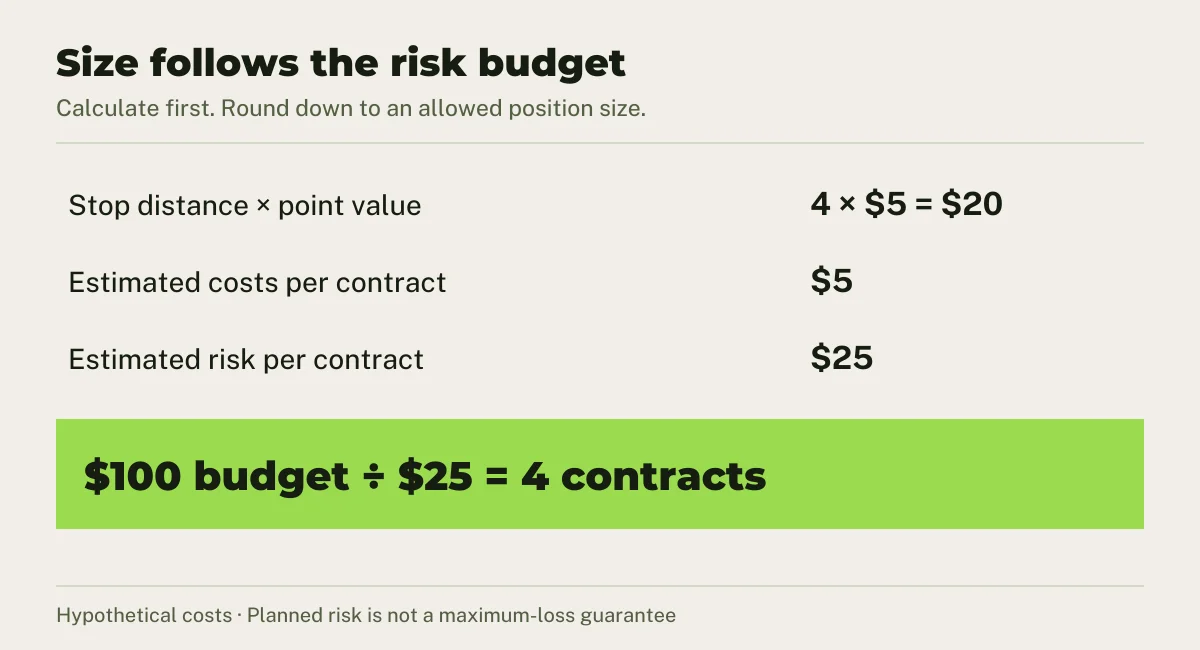
Hypothetical budget: $100. MES stop distance: 4 points. At $5 per point, price risk is $20 per contract. Assume $5 per contract for combined fees and adverse execution in this exercise. Estimated risk is $25; $100 ÷ $25 permits four contracts. A 6-point stop would cost an estimated $35 per contract, permitting only two.
Try it in replay
Use an $80 budget, a 3-point MES stop and the same hypothetical $5 per-contract cost allowance. Calculate size and unused budget. Then test a $15 budget.
Check your reasoning
Estimated risk is $20 per contract, so four fit $80. With only $15, not even one fits: pass. Never round 0.75 contracts up to one.