
Lesson 1
Five questions, one decision
Build confluence from distinct questions instead of collecting indicator votes.
Study time: about 8m
Lesson
Confluence means several observations support a coherent plan. More coloured lines do not automatically create more evidence. A trendline, a rising 200 EMA and an ordered EMA stack all describe aspects of price direction. Count them as one bias discussion rather than three independent votes.
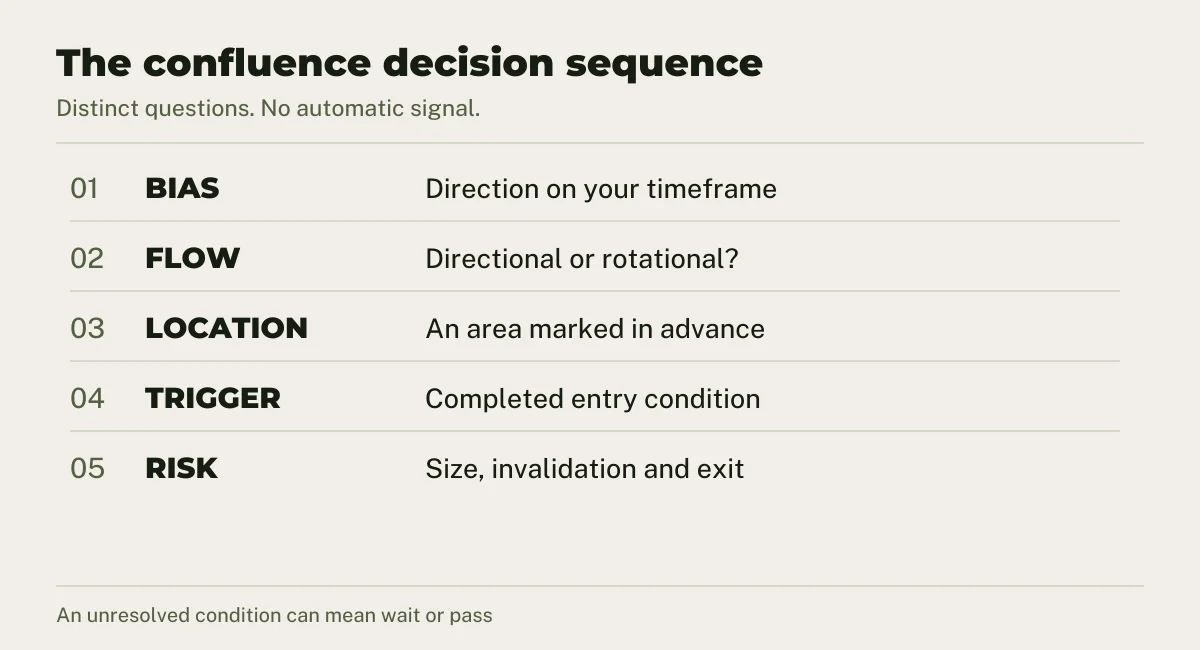
The Trading Hall decision sequence
- Bias: what does the chosen context timeframe support?
- Session flow: is price moving cleanly, rotating or becoming erratic?
- Location: where would a decision be meaningful?
- Trigger: what completed behaviour is required?
- Risk: can the plan be sized and exited within your rules?
Each question can disqualify the trade. A clear direction cannot repair impossible sizing. A precise entry pattern cannot remove an event restriction. Record both supporting and opposing observations; this is a framework for consistent practice, not a validated probability model.
Worked example
Price is above the 50, 100 and 200 EMAs, but it has repeatedly crossed session VWAP and is approaching an opposing prior high. Calling that “four confirmations” hides the conflict. A better description is “upward bias, choppy session flow, limited room, no trigger yet.”
Try it in replay
Take an old chart and fill in all five questions using one sentence each. Label the decision ready, wait or pass according to written rules, rather than assigning a confidence percentage.
Check your reasoning
Wait means a required condition has not arrived. Pass means a condition disqualifies the idea. Ready means the stated practice rules are satisfied; it does not mean the trade will win.