
Lesson 2
Turn price movement into money
Calculate ticks, point value and gross profit or loss before considering an entry.
Study time: about 8m
Lesson
A point is a unit of quoted price. A tick is the smallest permitted price increment for a product. In many currency pairs a pip refers to the fourth decimal place, but conventions differ. Never transfer a tick or pip value from one instrument to another.
For a linear contract, gross profit or loss equals price movement multiplied by the value per point and the number of contracts. Reverse the sign for a short position. If the contract settles in a different currency from your account, conversion also matters. Fees and slippage come after this basic calculation.
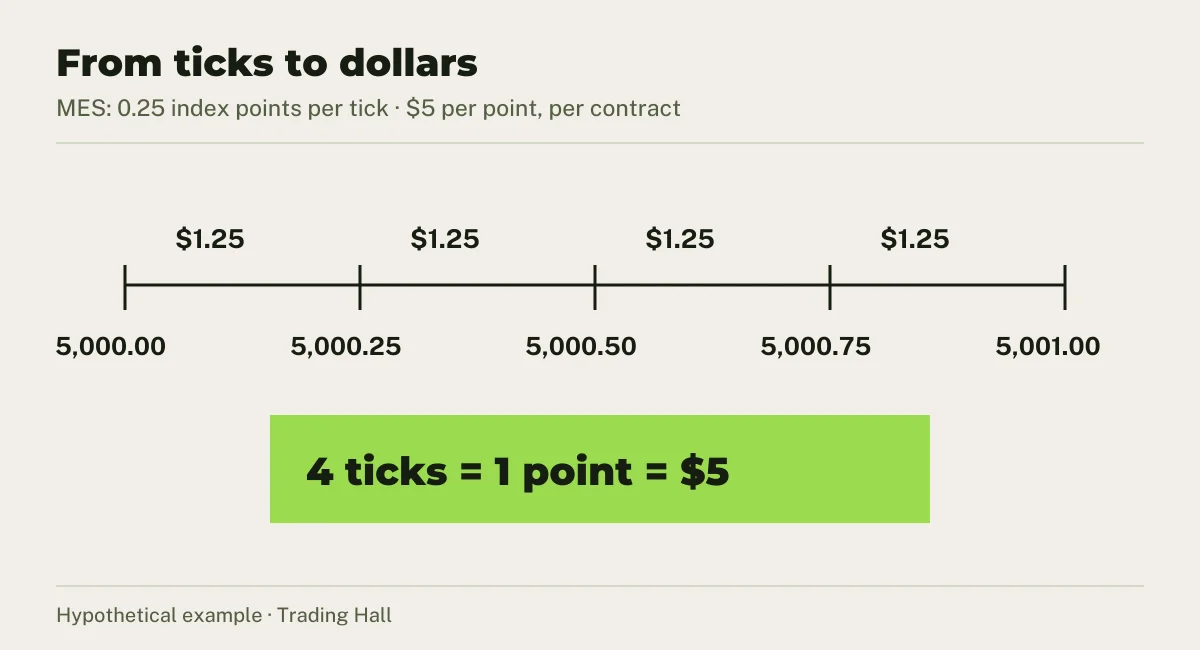
CME’s Micro E-mini S&P 500 futures contract, MES, has a $5 multiplier per index point and a 0.25-point minimum tick. That makes one tick $1.25 per contract. The larger E-mini contract is a different product; similar names do not mean interchangeable sizing.
Worked example
Hypothetically, one MES contract bought at 5,000.00 and sold at 5,003.00 moves 3 points: 3 ÷ 0.25 = 12 ticks. Gross profit is 12 × $1.25 = $15. Two contracts would produce $30 before costs. The same move against a short would be a gross loss.
Try it in replay
Calculate the gross loss on two MES contracts if a long entry at 5,000.00 exits at 4,996.50. Write the result in points, ticks and dollars.
Check your reasoning
The adverse move is 3.5 points, or 14 ticks. Each contract loses $17.50, so two lose $35 before costs. A chart move is not an account result until size is included.