
Lesson 4
Separate a sweep from a breakout
Read a move beyond a reference level and back inside without inventing its cause.
Study time: about 8m
Lesson
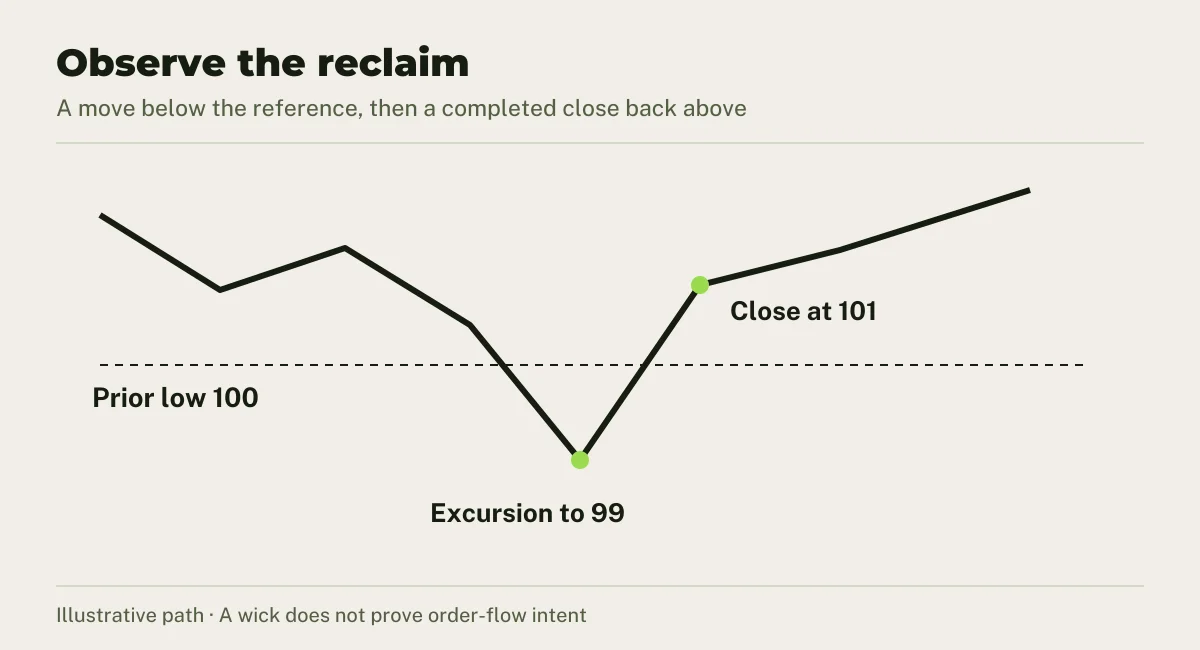
Traders often call a brief move beyond a prior high or low followed by a return inside a “liquidity sweep.” What you can observe is the excursion, the close and subsequent price behaviour. A wick alone does not prove stop hunting, institutional buying or remaining orders.
Define the reclaim on a specific timeframe. A close back inside can be one condition; holding that area on a later retest can be another. Waiting changes the entry price, so recalculate risk and room to the target instead of keeping the original idealized entry.
A three-candle fair value gap is another chart convention. In a bullish version, the first candle’s high sits below the third candle’s low. That non-overlap does not mean no trading occurred through the zone, and it does not require a future fill. Keep the observable geometry separate from the story attached to it.
Worked example
A prior low sits at 100. Price trades to 99, then the selected candle closes at 101. This is a reclaim under a close-based rule. If the next bars accept below 100, the hold thesis weakens. Buying at 102 because of a later trigger has different risk from buying at 99.
Try it in replay
Write two alternative descriptions: one for a reclaim that holds and one for a break that remains below the level. Identify when each description becomes observable.
Check your reasoning
A reclaim requires the return your rule specifies; a sustained break needs evidence beyond the first wick. Neither description supplies position size or proves the next direction.