
Lesson 2
Freeze the opening range
Calculate the high, low and width using only the completed opening window.
Study time: about 10m
Lesson
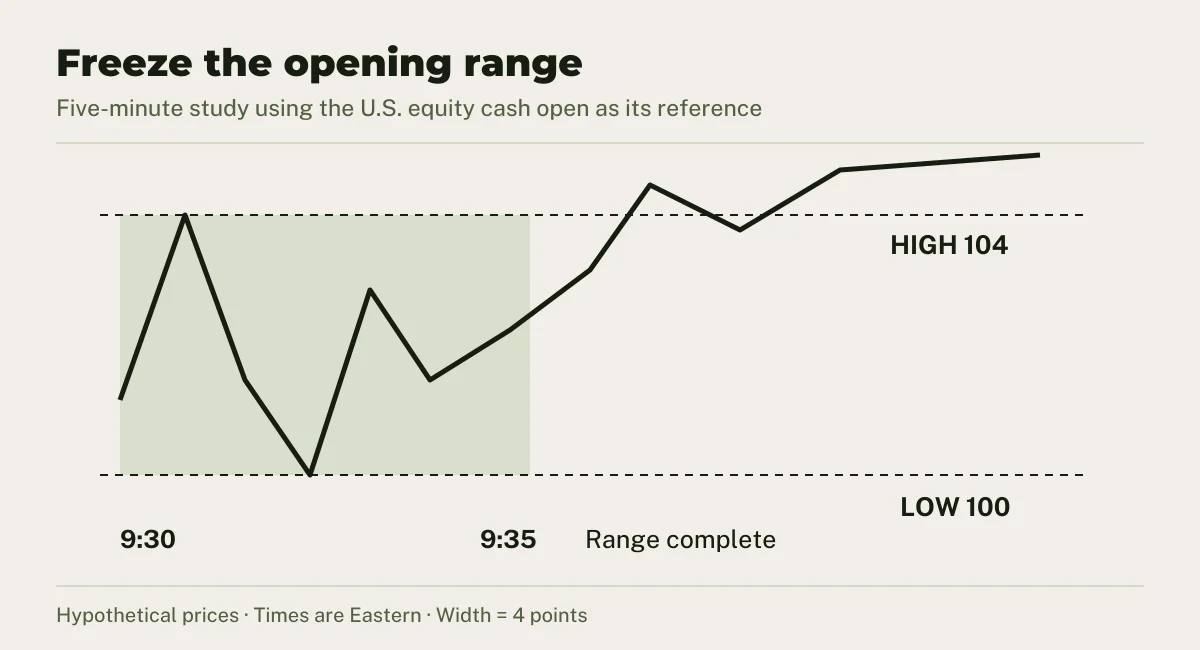
At the end of your chosen window, record its highest traded price and lowest traded price. Width equals high minus low. Keep those boundaries fixed for that day’s study. Extending the range after seeing a failed break changes the original setup.
Decide in advance how to handle missing bars, data gaps and an unusually wide or narrow range. A wide range can make a far-side stop expensive; a very narrow range can make spread and noise large relative to the setup. Use recorded criteria rather than declaring a range acceptable because the later move looks attractive.
Map nearby higher-timeframe references separately. Opening-range boundaries do not erase yesterday’s high or an overhead resistance area. You still need enough room for the exit plan and a position size that fits the loss budget.
Worked example
A hypothetical opening window reaches 104 and falls to 100, producing a 4-point range. A one-range projection above the high is 108, while one below the low is 96. These are measurement references, not promised targets. A later high at 106 does not change the frozen opening high of 104.
Try it in replay
Calculate width and one-range projections for a window with high 250.50 and low 247.00. Record the first time the range could be known.
Check your reasoning
Width is 3.50 points; the projections are 254.00 and 243.50. The range is known only when the selected window finishes, not when its eventual high happens to print.